
Aura After Aura
Introduction: Part 1

There is a temptation I feel in the body—the gravity of it, the drug. The pull to fall into the news, to engage, to rage against injustice, to chase the corrupt messenger and the next corrupt messenger after that. How can one not pay attention, especially when the air carries an echo of the last century—when, from our vantage point, the progression toward cataclysm feels suddenly legible again, as if history is tweaking the same old knobs. I was born in 1972; my life unfolded in the long afterglow of Europe’s catastrophe, in the decades where we told ourselves the world hahd learned. And yet the atmosphere changes. You can almost watch it happen the way you watch weather: clouds gathering above a great plain, forming, thickening, moving closer and closer until the sky has weight. The most unsettling part is the thought that keeps returning—our private vow, our retrospective innocence: if we had seen what was coming, we would have gotten out; we would never have stayed; we would never have been part of it. But what if seeing is not the issue? What if the real question is how to keep perception from being captured—how to keep communication alive—before the gathering becomes a closed loop we can’t step outside. What if the reason we don’t leave isn’t that we didn’t see it coming, but that the coming storm is mesmerizing—so we stay too long watching it approach?
When fear pulls us into binaries and the echo starts to feed on itself, art keeps the channel open—heart-led, symbolic—so catastrophe doesn’t harden into ruin, but turns into husk: proof that something living has passed through.
By “echo,” I mean something more technical than mood. In sound, feedback is the screech or hum that happens when a fraction of an amplifier’s output returns to its own input—when the speaker faces the microphone and the system forms a closed loop that can only feed itself, getting louder and harsher. That is how public life can begin to feel: signal feeding signal, one reaction returning as the next condition of speech, until the conversation can’t hear anything but its own amplification.
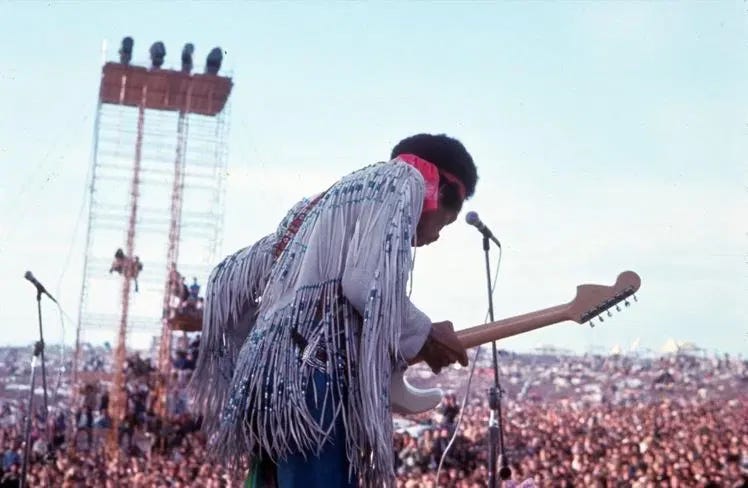
And yet feedback isn’t only failure. It’s raw energy. In the one orientation it becomes a deafening howl; in the right hands it becomes language. Drop the needle on Hendrix live at Woodstock and listen to what happens: the shriek is not denied—it’s ridden. What could overwhelm becomes articulation. The loop is kept from swallowing the music, and the result holds more than one truth at once—beauty braided with unease, reverence braided with rupture.
Long before this season of media storm and signal, the German cultural critic Walter Benjamin tried to name what modern technologies were doing to perception—how reproduction and mass circulation change what art is and how we meet it. His word for what thins in the process is aura: the strange distance that makes a thing feel singular and present, even when you are close. With that in mind, Hendrix at Woodstock becomes more than a famous performance: it becomes a parable of the present—feedback as the sound of a closed loop, and art as a way of keeping the loop from overwhelming the music.
Aura isn’t a halo. It isn’t an emotional state. It’s a relationship: the feeling that something stands before you with its own gravity, its own threshold, its own being. You can approach it, but you can’t quite consume it. Aura is the boundary that slows us down—not as elitism, but as a condition of encounter. It’s what makes a work feel like more than an image among images.
If aura is the felt threshold of presence, then its decay is also the decay of a certain inner sense—the ability to encounter without control. That loss has the shape of exile: a long desert journey in which the sacred doesn’t vanish, but becomes harder to locate, appearing only in brief oases. I will return to this more directly later; for now it is enough to name the drift: we enter a desert of disenchantment, surviving on thin rations of sensation and spectacle—and mistaking that for life.
And this, for Benjamin, is the crucial point: aura is not an eternal property that artworks “have.” It is historically formed. A work’s singular presence—its “here and now”—is bound to tradition: not tradition as nostalgia, but tradition as an inherited way of approaching things, a grammar of attention. When the grammar changes, what counts as “presence” changes with it.
Once reproduction pries the work loose from that inherited grammar—once the criterion of authenticity stops anchoring the encounter—Benjamin says the center of gravity shifts. The work is no longer held primarily in the shelter of ritual; its social destiny turns outward, toward the public field. In his stark phrase, the total function of art is reversed: no longer based on ritual, it begins to be based on politics. What becomes newly possible is not only wider access, but wider use—the work as something deployable, captionable, recruitable.
Accepting a spiritual nature in the human doesn’t refute that reversal; it changes where we locate the center of gravity. The decisive question becomes not only what institutions art serves, but what faculty in the perceiver the work is training. Ritual, at its best, thickens presence without coercion; politics, at its best, expresses conscience in the shared world without turning the human being into an instrument. In a desacralized age, both can be corrupted into spectacle—each feeding the other in a closed loop. But art can interrupt the loop by returning perception to relationship: a symbolic, heart-led way of holding two truths at once, so we aren’t trapped in reaction. In that sense, the “spiritual” doesn’t abolish the polarity; it redeems it: the work becomes less a tool of cult or party than a practice of inner formation—like Hendrix riding feedback into music, keeping the channel open long enough for something human to be heard.
to be cont’d
I was at Woodstock when Jimi Hendrix played the Future.
I needed to read and reread paragraphs to recapture your explanations /definitions/ of ritual vs/with/also political . Jimi Hendrix guitar work was a sanctified example . FYI i found you through Patti Smith’s substack.
Thank you 😊