
The Gate of the Light-God
Ahura Mazda, the Christ Being, and the Strait of Hormuz

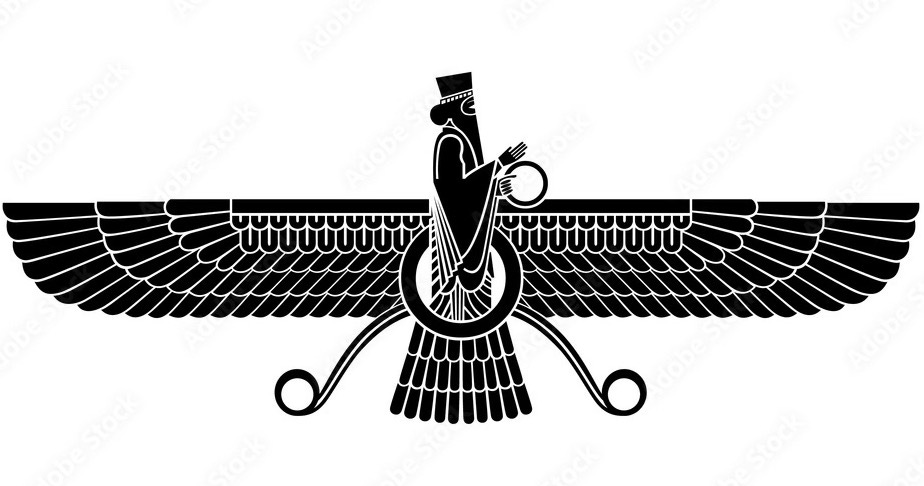
Back in January, I was researching the Strait of Hormuz. What was its history? What does Hormuz mean? I was amazed at what I found. Here is the essay I wrote about it. It was published in the summer issue of “being human,” the Anthroposophical Society in America’s bi-annual publication for members. I reprint it here for those who may not have seen “being human’” or, for that matter, be aware of the Anthroposophical Society in America.
**
The Gate of the Light-God
Ahura Mazda, the Christ Being, and the Strait of Hormuz
There is a narrow strip of water between Iran and Oman, roughly twenty-one miles wide at its tightest point, through which flows approximately one-fifth of the world’s seaborne oil and a significant fraction of its liquefied natural gas. Strategists call it the world’s most important chokepoint. Geographers call it the Strait of Hormuz. What almost no one remembers is that this waterway bears the name of a god — and not just any god, but the supreme deity of Zoroastrianism, the ancient Persian religion that gave Western civilization some of its deepest spiritual architecture. Hormuz is a corruption of Ormuzd, itself a Middle Persian rendering of Ahura Mazda: the Lord of Wisdom, the Great Sun Spirit, the Wise Lord of Light. That petroleum — the distilled residue of ancient organic life, the fuel of materialism itself — must pass through a strait named after the god of spiritual light is one of the stranger ironies available to the contemplative mind.
The Austrian mystic Rudolf Steiner devoted a remarkable body of lectures, preserved in the Rudolf Steiner Archive, to Ahura Mazda’s significance in the evolution of human consciousness. Steiner’s point of departure is Zarathustra, the ancient Persian prophet who founded Zoroastrianism perhaps four thousand years ago. Where the Indian sages of his era taught disciples to withdraw from the outer world as illusion — as maya — Zarathustra made the opposite gesture.Look outward, he said. Look at the sun. But do not stop at the physical light. Behind the radiant body of the sun lives a vast spiritual being, the Great Aura, the Ahura Mazdao. Just as the human spirit might be called the little aura — a personal luminous field — Ahura Mazda is the Great Aura: the all-encompassing spiritual Sun behind the physical one. Zarathustra’s revolutionary teaching was that matter is not the enemy of spirit but its garment — that if you truly understand the physical, you see through it to the divine.
This insight carried a moral corollary. Opposing Ahura Mazda in the cosmos is Angra Mainyu, better known in Steiner’s usage as Ahriman — the Spirit of Darkness, the principle of falsehood and materiality who would have humanity believe that the physical world is all there is. Ahriman does not tempt through passion or ecstasy — that is Lucifer’s domain. Ahriman tempts through reduction: through statistics, mechanism, and the dogma that only what can be measured deserves to be called real. In Zarathustra’s cosmos, every human moral act participates in this cosmic battle between Ahura Mazda and Ahriman, between the light that integrates and the darkness that diminishes.
Steiner’s most astonishing claim — and the hinge around which his entire Christology turns — is that Ahura Mazda, the Vedic Vishva Karman, the Egyptian Osiris, the Hebrew YHWH revealed in the burning bush, and the Christ of Golgotha are all names for the same cosmic being at different stages of its approach to Earth. From deep within the spiritual cosmos, this Sun Being wasalways present but not yet incarnate. Different cultures glimpsed it through their most advanced initiates: the Rishis saw it as beyond their sphere, Zarathustra identified its dwelling as the sunitself and prophesied its earthly descent, Moses received its name as the great “I AM,” and finally itincarnated in the body of Jesus of Nazareth and passed through death and resurrection at Golgotha. That event, for Steiner, was the central act of all earthly evolution: the Sun Spirit entered the Earth and transformed its very spiritual substance.
“Zarathustra spoke to his chosen pupils of Ahura Mazdao who dwelt spiritually behind the sunlight, and said: Behind the sun is something not yet united with the earth, but which will one day stream forth into earthly evolution and descend to earth.” — Rudolf Steiner, GA 123
This is not syncretism in the casual sense — a blurring of traditions for comfort. It is a precise evolutionary claim: each civilization received exactly the revelation appropriate to its stage of development. The Persians, as farmers and warriors engaged with the physical world, needed a teaching that sanctified matter rather than fled it. Ahura Mazda gave them that: a framework in which tilling the earth, cultivating crops, and resisting the lying power of Ahriman were all sacred acts. The spiritual was not elsewhere — it was here, embodied in light and soil and honest labor.
Steiner situates Ahura Mazda within a vast arc of three cosmic incarnations: Lucifer in human flesh during the third millennium before Christ, the Christ incarnation at the turning point of time, and the coming incarnation of Ahriman in the West within the third millennium after Christ. Lucifer — the light-bearer in his fallen mode — gave humanity premature spiritual illumination, inflaming mystical and fanatical tendencies. Ahriman has been steadily tightening his grip since the Renaissance, encouraging the worldview that matter alone is real. The Christ stands between them as the balancing principle — and humanity’s task is to consciously hold that equilibrium. Steiner’s Christ is not meek but is the supreme equilibrist of cosmic forces, the being who, in the famous Dornach sculpture, stands with one hand redirecting Lucifer’s flight and the other restraining Ahriman’s crystallizing power.
What makes the Hormuz connection so charged is that petroleum — the substance flowing through the strait — is, in esoteric terms, a deeply Ahrimanic force. It is the concentrated residue of ancient life, hardened into matter, burned to drive mechanical civilization. The industrial economy built on oil is precisely the kind of world Ahriman would design: quantified, efficient, spiritually opaque, and deeply addictive. That this economy’s jugular vein passes through a strait named after the principle opposing Ahriman — named, literally, after the Sun Spirit who would become the Christ — suggests something that resists easy categorization as mere coincidence.
The name Hormuz traveled a long road from ancient Persia. Ahura Mazda becameHormazd in Middle Persian Pahlavi, then Hormuzd, then Hormuz — the name of a medieval island kingdom that controlled trade between India, China, and the Persian Gulf. Marco Polo visited twice. The Portuguese seized it in 1507. A joint Persian-English force expelled them in 1622.
Empires came and went, but the name persisted on every map in the world — the name of the Lord of Light, attached to the world’s most strategic commercial passage. Today, with Iran and regional powers regularly invoking the strait’s closure as a geopolitical weapon, the waterway oscillates between its two mythic poles: the Light it is named for, and the Darkness that would use it as a lever. Steiner might have observed that this is preciselythe nature of the Ahrimanic age — that the most sacred geographical names become attached to the most materially consequential sites, as if history itself were leaving a coded commentary on the spiritual stakes beneath the surface of events. The strait named after the god of order and wisdom has become the hinge on which global disorder swings.
What Zarathustra proclaimed across the ages — that the spiritual is present in the physical, that matter is the garment of the divine — finds a strange contemporary echo here. The question Steiner would likely press is not geopolitical but inward: will humanity approach this vulnerable point with the consciousness that its name demands? Can the Gate of the Light-God be navigated with wisdom rather than merely with warships? The ancient Persian prophet saw the whole universe as a moral drama. Standing at the Strait of Hormuz, it is not difficult to see why.